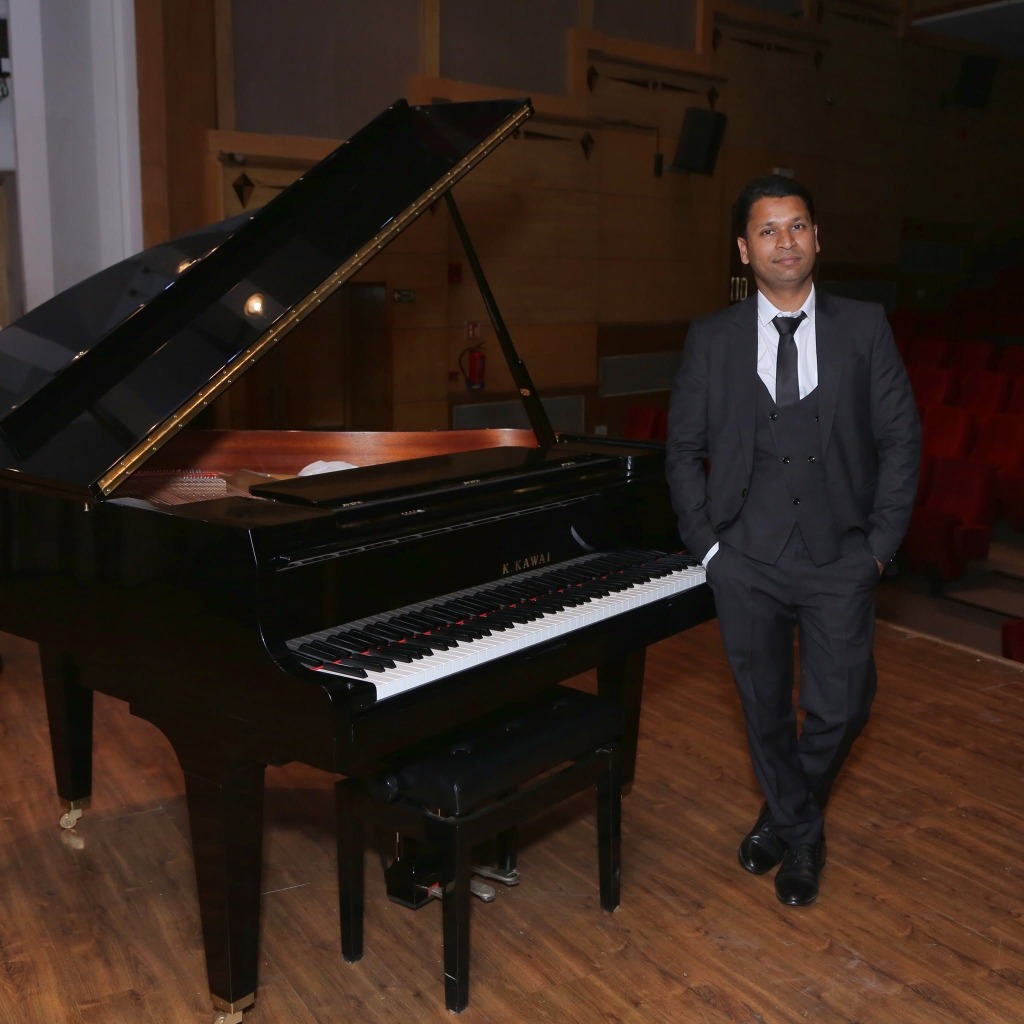
The Foundation of Classical Technique: The Mechanical Keybed
Why the First Instrument You Touch Determines Your Musical Ceiling
One of the most frequent questions posed by beginners and parents across Delhi NCR is: *'Can we start learning on an inexpensive 61-key portable keyboard, and upgrade to an 88-key weighted piano later once we know the child is interested?'*
While this instinct is understandable from a budget perspective, it represents one of the most destructive misconceptions in musical education. Learning on an unweighted or semi-weighted keyboard does not give a student an 'easy start'; rather, it teaches them an entirely different physical discipline that cripples their ability to ever play a real piano.
To play the piano is to engage in an intimate physical conversation with weight, inertia, and mechanical resistance. When a student practices on spring-loaded plastic keys, their fingers, wrists, and arms develop faulty neuromuscular patterns that require painful, protracted rehabilitation to correct.
With twenty-five years of conservatory-grade teaching experience, Syed Sajjad Rasul provides this exhaustive technical analysis to explain why serious pianists never compromise on an 88-key fully weighted hammer action keybed.
Biomechanical Comparison: Hammer Action vs. Spring Resistance
How Keybed Physics Directly Impacts Hand and Tendon Anatomy
To understand why keybed mechanics are non-negotiable, one must contrast the physical mechanisms:
1. The Mechanics of an Acoustic Piano & Fully Weighted Digital Action: In an authentic piano keybed, the key is a wooden teeter-totter lever. When depressed, it lifts an independent felt hammer. The resistance felt by the finger is the inertia of that moving hammer. Crucially, once the hammer is launched and reaches the 'escapement' point, the resistance drops away, allowing the finger to rest comfortably on the keybed with zero upward spring tension. The finger uses the natural gravitational weight of the arm, cushioned by a supple wrist.
2. The Flaw of Semi-Weighted and Synth Action: Semi-weighted keyboards rely on coiled steel springs located beneath the back of the key. When you press a spring-loaded key, the resistance increases linearly the deeper you press. Worse, the moment you reach the bottom of the keybed, the spring pushes forcefully back upward against the delicate flexor tendons of the finger.
The Physiological Consequences: • Collapsed Knuckle Arches: Because spring keys lack initial resistance, the student's third knuckles collapse flat against the hand. • Forearm and Tendon Strain: The constant upward pressure from springs causes chronic tension in the forearm flexors, capping speed and risking repetitive strain injury (RSI). • Zero Dynamic Velocity Control: On an acoustic piano, dynamic volume is determined by the speed (velocity) of the hammer strike. On spring keyboards, volume is electronically simulated by rubber velocity switches, preventing students from mastering true pianissimo and fortissimo nuances.
Keybed Action Comparison Matrix: Weighted vs. Semi-Weighted vs. Synth
A Technical & Pedagogical Breakdown for Discerning Pianists
As clearly detailed, an 88-key graded hammer action keybed is not a luxury—it is the baseline requirement for authentic piano education.
| Action Architecture | Mechanism | Dynamic Expressiveness | Hand Anatomy Impact | Suitability for Classical Music |
|---|---|---|---|---|
| 88-Key Graded Hammer Action | Physical weighted hammers mimicking acoustic leverage | Infinite micro-nuance; genuine velocity-driven tone | Strengthens finger bridges; builds relaxed, shock-absorbing wrists | Mandatory standard for classical study & Trinity exams |
| 88-Key Semi-Weighted Action | Plastic keys with lead weights & spring assist | Limited dynamic range; inaccurate velocity curve | Induces finger flattening; inconsistent finger independence | Unsuitable for serious classical; acceptable for casual synth pop |
| 61-Key Unweighted Synth Action | Lightweight hollow plastic with pure spring return | Binary or crude touch sensitivity; zero hammer inertia | Severe knuckle collapse; tense wrists; zero finger bridge strength | Prohibited for classical piano; useful only for music production / MIDI |
| Acoustic Concert Grand Action | Solid spruce keys, double-escapement repetition | Unmatched acoustic resonance, overtones & pedal nuance | Ultimate anatomical synergy; pure weight-transference mastery | The gold standard of world conservatory performance |
The 61-Key Compass Limitation: Missing the Architecture of Masterpieces
Why Serious Classical Repertoire Demands All 88 Keys
Beyond the mechanical touch, there is the fundamental issue of the musical compass. A standard acoustic piano features 88 keys—seven full octaves plus a minor third (A0 to C8). A 61-key keyboard omits more than two full octaves of pitch.
Even at the early intermediate grades of Trinity College London, classical repertoire requires the full width of the keyboard: • Deep Bass Resonances: The rich pedal points and sonorous chords of Beethoven, Chopin, and Rachmaninoff plunge into the lowest contra-octaves. • Sparkling Treble Flourishes: Classical sonatinas and romantic nocturnes require delicate, bell-like runs in the sixth and seventh octaves. • Spatial Posture & Lateral Arm Travel: Practicing on an 88-key instrument trains the torso to balance effortlessly while the arms travel across the entire keybed. Practicing on a 61-key keyboard confines the arms to a narrow physical box, throwing off spatial memory and body mechanics.
Recommended 88-Key Weighted Digital Pianos in India (2026)
Curated Models for Discerning Students
For families residing in apartments or residences where an acoustic upright piano is temporarily impractical, Syed Sajjad Rasul recommends selecting from these premier 88-key weighted digital instruments:
Compact Stage Pianos (Ideal for Study Rooms): • Yamaha P-145 / P-225: Equipped with Yamaha's Graded Hammer Compact (GHC) action, providing excellent portable resistance and authentic acoustic grand sound sampling. • Roland FP-30X: Renowned for its PHA-4 Standard keybed with escapement simulation and ivory-feel keys, offering superb mechanical resistance for finger strengthening. • Kawai ES-120: Features Kawai's Responsive Hammer Compact (RHC) action, prized for its quiet key travel and warm, singing harmonic samples.
Furniture Consoles (Ideal for Living Salons): • Yamaha Clavinova CLP-735 / CLP-745: GrandTouch-S keyboard action with wooden white keys, synthetic ebony/ivory keytops, and binaural acoustic grand samples. • Kawai CA49 / CA59: Real wooden-key actions with extended pivot lengths that replicate grand piano mechanics with astonishing realism.
Expert Instrument Consultation with Syed Sajjad Rasul
Ensure Your Home Setup Supports Flawless Progress
Before investing in any digital or acoustic piano, speak with an experienced master pedagogue who understands the mechanical demands of international examinations.
Syed Sajjad Rasul evaluates your child's hand anatomy and your home space to recommend the optimal instrument. Ensure your child begins their musical journey with the correct physical mechanics from day one.
Reach out via WhatsApp or phone to book a private consultation.
The Biomechanics of Tendon Health: Avoiding the Pitfalls of Stiff Spring Action
Protecting the Delicate Hands of Growing Children
The human hand was not biologically engineered to press spring-loaded keys. The forearm contains two primary muscle groups responsible for finger movement: the *flexor digitorum superficialis* and the *flexor digitorum profundus*. These muscles connect to the finger bones via delicate tendons running through the carpal tunnel.
When a child practices on a semi-weighted keyboard: • The spring constantly pushes upward against the finger while the key is held down. This forces the flexor muscles to remain contracted even when resting on the keybed. • Over time, this chronic static contraction leads to tendon inflammation, forearm tightness, and fatigue after just fifteen minutes of playing. • On a fully weighted hammer-action piano, the inertia of the hammer is overcome during the downward strike, and the key can be held down with minimal gravitational pressure. The student learns to play with completely relaxed muscles, enabling hours of effortless practice.
Escapement Mechanics: What Beginners Need to Know
The Subtle Mechanical Sensation That Enables Virtuosity
In an acoustic grand piano, the 'escapement' mechanism (also known as the 'let-off') allows the hammer to disengage from the key mechanism right before striking the string. When a pianist presses a key very slowly, they can feel a subtle, gentle 'notch' or resistance release about two-thirds of the way down.
Why does this matter? • Escapement allows a pianist to play whisper-soft pianissimo passages with absolute control, knowing exactly where the hammer triggers. • It enables rapid note repetition without needing the key to return all the way to its resting position. • High-end digital pianos (such as the Roland FP-30X or Yamaha Clavinova series) simulate this escapement feel, allowing serious students to develop the micro-touch required for advanced classical repertoire.
The Transition from Digital Weighted Keys to Acoustic Grands
Bridging the Gap for Concert Performances
While an 88-key weighted digital piano provides an excellent home practice foundation, students must regularly experience acoustic touch before recitals and examinations. Syed Sajjad Rasul ensures students practice on fine acoustic uprights and baby grands, developing acoustic projection and pedal overtone mastery.
Double-Escapement Repetition Speed: Why Virtuosity Demands Physical Hammers
Understanding the Mechanical Engine of Grand Piano Artistry
In 1821, French piano builder Sébastien Érard patented one of the greatest mechanical breakthroughs in musical history: the double-escapement (repetition) mechanism.
On a standard upright or basic keyboard, once a key is struck, it must return almost entirely to its top resting position before the hammer can be triggered again. This limits rapid note repetition to a slow, clumsy tempo.
The double-escapement mechanism utilizes an auxiliary spring and repetition lever that catches the hammer halfway down its rebound. This allows the pianist to re-strike the same note repeatedly at lightning speed without releasing the key completely. • Why This Matters for Classical Repertoire: Masterpieces like Liszt's La Campanella, Scarlatti's Sonata in D Minor, and Beethoven's Waldstein Sonata rely heavily on rapid repeated notes. A student practicing on a semi-weighted keyboard simply cannot perform these works because the spring mechanism cannot reset in time. • Building Micro-Kinetic Agility: Practicing on a keybed with authentic double-escapement simulation teaches the fingers to 'hover' and articulate from the key surface, developing the delicate touch required for world-class classical performance.
Pedal Mechanics: Decoupling Binary Switches from Continuous Half-Damping
Mastering the Soul of the Piano
Anton Rubinstein famously observed that 'the pedal is the soul of the piano.' Yet on inexpensive keyboards, the sustain pedal is nothing more than a cheap plastic binary on/off switch: either 100% sustained or 100% dry.
On an authentic acoustic piano and fine weighted digital consoles: • The sustain pedal operates continuously. The pianist can use half-pedal, quarter-pedal, and flutter-pedal techniques to wash overtones together gently without creating harmonic mud. • The student learns to listen to the acoustic decay through the room's air, clearing resonances with microscopic foot adjustments. • Practicing on unweighted keyboards with binary pedals makes authentic acoustic pedaling impossible to learn.