Dismantling the Great Adult Myth: 'Am I Too Old to Learn?'
Why Mature Minds Learn Classical Piano with Exceptional Depth
There is a pervasive and tragic myth in the world of music: the belief that unless one began practicing scales at age four, the doors of classical piano mastery are forever sealed. Many corporate managing directors, senior surgeons, venture capitalists, and civil servants in Delhi harbor a lifelong dream of playing the piano, yet hesitate because they fear it is 'too late.'
This fear is entirely unfounded. While young children possess exceptional neuro-elasticity for rote mimicry, adults possess cognitive, analytical, and emotional advantages that make them extraordinary pianists:
- ▸Superior Pattern Recognition:
- ▸An adult mind easily grasps the mathematical architecture of Western music—the symmetry of scale patterns, the logic of the circle of fifths, and the architectural symmetry of harmonic cadences. What takes a six-year-old months to memorize through rote repetition, an adult grasps intellectually in minutes.
- ▸Profound Emotional Maturity:
- ▸Music is not merely the striking of keys; it is the communication of the human condition. A child playing Chopin's *Nocturne in C-sharp Minor* can only mimic expressive inflection. An adult—who has experienced love, ambition, loss, and resilience—infuses every note with authentic emotional resonance.
- ▸Self-Directed Intentionality:
- ▸Unlike children who are often pushed to practice by their parents, an adult sits at the piano by conscious choice. Every minute spent practicing is driven by pure passion and intellectual desire.
The Neuroscience of Executive Flow: Piano as High-Performance Cognitive Wellness
Restoring Bilateral Balance in an Overstimulated Leadership Brain
For CEOs, founders, and senior professionals in Delhi NCR, the demands of leadership are mentally exhausting. Constant strategic evaluations, crisis management, and the relentless stream of digital notifications leave the executive prefrontal cortex in a state of chronic sympathetic over-activation.
Traditional relaxation methods often fail because an active, high-performing mind cannot simply 'turn off' during passive leisure. Classical piano provides a transformative alternative: active cognitive sanctuary.
- ▸Bilateral Hemispheric Decoupling: Reading polyphonic music forces the left hand to control a complex contrapuntal bassline while the right hand phrases a lyrical melody with subtle rubato. This forces the left and right hemispheres of the brain to communicate via the corpus callosum with blazing speed.
- ▸Dopamine Modulation and Stress Eradication: Achieving clean articulation of a challenging musical phrase triggers a release of dopamine and lowers cortisol, resetting the nervous system.
- ▸Complete Digital Disconnection: At the acoustic piano, there are no screens, no pop-ups, and no algorithmic distractions. You are immersed in a pure, tactile analog world of wood, felt, steel, and resonance.
Adult Learning Myths vs. Neuroscientific Reality
A Clear Analysis for Aspiring Adult Pianists
This comparison makes it clear: being an adult is not an impediment to learning the piano—it is your greatest competitive asset.
| Common Adult Fear / Myth | Pedagogical & Neuroscientific Reality | Syed Sajjad Rasul Studio Approach |
|---|---|---|
| 'My adult fingers are too stiff to learn' | Finger stiffness is purely muscular tension, not bone structure; relaxation exercises restore fluid mobility rapidly | Ergonomic Russian school relaxation techniques release wrist tension within the first three lessons |
| 'I have to spend years on baby nursery rhymes' | Juvenile primers are designed for children with limited vocabularies; adults can immediately learn sophisticated harmony | Bypasses all primers; students immediately play mature harmonic progressions, Bach, and Satie |
| 'I don't have hours every day to practice' | Adults practice with deliberate focus; 25 minutes of intentional daily practice achieves remarkable compounding progress | Customized micro-practice routines designed to fit high-stakes corporate and medical calendars |
| 'I will look foolish if I make mistakes' | Errors are simply diagnostic feedback loops that illuminate neural pathways | Complete, confidential 1-on-1 privacy in a refined studio or in-home salon setting |
| 'Classical music theory is too difficult' | Music theory is beautifully logical and mathematical; highly intuitive for analytical minds | Accelerated harmonic deconstruction: chords, voice leading, and cadence architecture |
An Accelerated Repertoire Designed for the Discerning Adult
From Erik Satie to Chopin and Film Scores
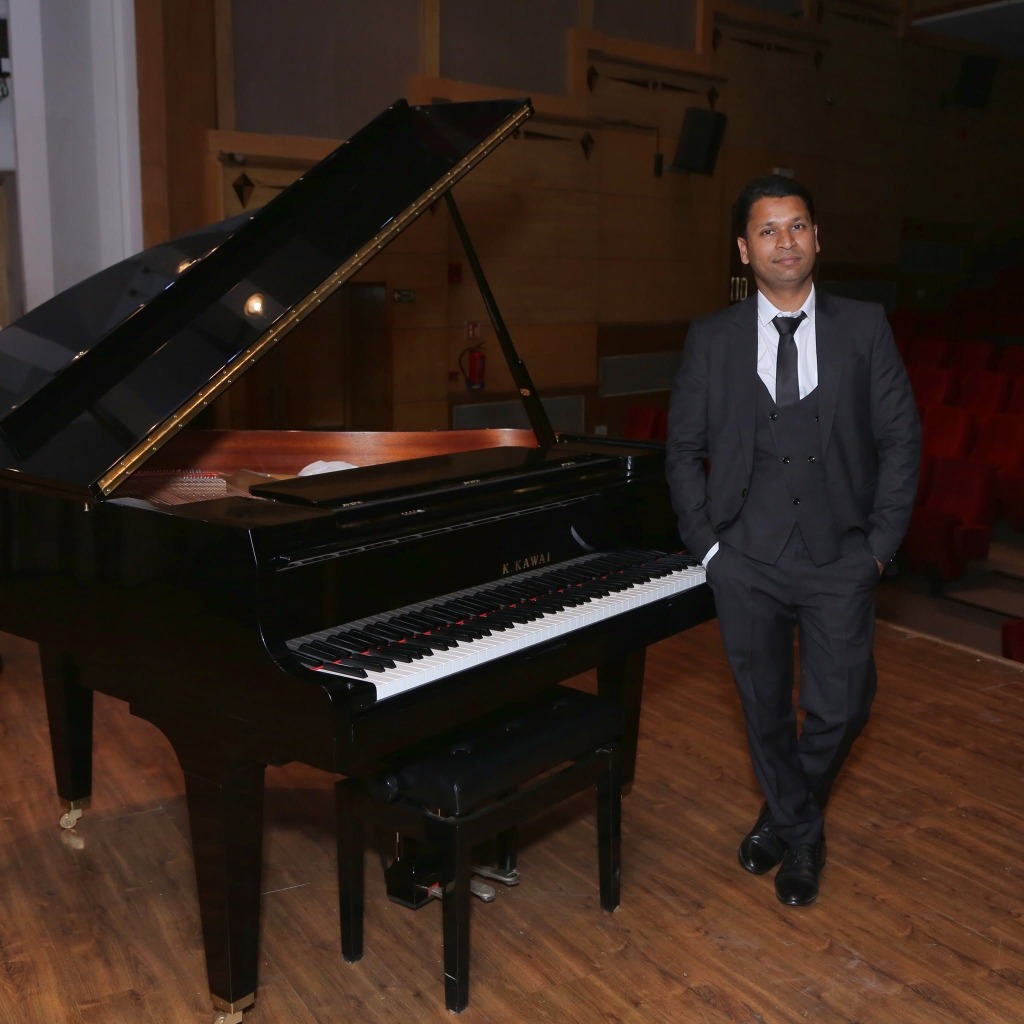
Under the master mentorship of Syed Sajjad Rasul, adult learners do not waste time on trivial exercises. Within the opening weeks of study, students are introduced to authentic, emotionally mature classical literature: • The Minimalist Elegance of French Impressionism: Erik Satie’s *Gymnopédie No. 1* and *Gnossienne No. 1*, cultivating touch, pedaling, and spacious phrasing. • The Architectural Grandeur of J.S. Bach: *Prelude in C Major (BWV 846)*, developing finger independence and polyphonic clarity. • The Lyrical Pathos of Romanticism: Chopin’s *Waltz in A Minor (Op. Posth.)* and *Prelude in E Minor (Op. 28 No. 4)*, mastering cantabile voicing and rubato. • Cinematic & Contemporary Crossover: Ludovico Einaudi’s *Nuvole Bianche*, Hans Zimmer’s *Interstellar Theme*, and Yann Tiersen’s *Comptine d'un autre été*.
Discretion, Privacy & Bespoke Executive Scheduling
Tailored to Demanding Professional Lives Across Delhi NCR
Master Sajjad understands that leaders have unpredictable schedules. Whether you reside in Vasant Vihar, Chanakyapuri, Golf Links, or DLF Phase 5 Gurugram, sessions are arranged with complete discretion: • Flexible Timings: Early morning sessions before the workday begins, or peaceful evening slots to decompress after high-stakes meetings. • Private In-Home Tuition: Mentorship conducted in the absolute privacy of your residence. • International Certification Optionality: Adult students who desire structured external validation can prepare for Trinity College London graded exams and performance diplomas with guaranteed distinction outcomes.
Schedule Your Confidential Executive Consultation
Begin Your Personal Classical Odyssey Today
Learning the piano as an adult is one of the most rewarding, deeply restorative commitments you can make to your intellectual and emotional life.
Connect directly with master pedagogue Syed Sajjad Rasul via WhatsApp or telephone to arrange an introductory consultation and diagnostic touch evaluation.
Reclaim your artistic passion with a mentor who respects your intelligence, your time, and your aesthetic ambitions.
Neurobiology of the Adult Brain: Myelinogenesis Through Polyphony
How Classical Piano Sharpens Executive Cognitive Agility
For decades, neuroscientists believed that the adult brain was relatively fixed in its structure. Modern neuroimaging has completely overturned this assumption. When an adult engages in a complex fine-motor and analytical activity like classical piano, the brain undergoes active myelinogenesis—the production of protective myelin sheaths around neural axons that accelerates signal transmission speed.
For senior professionals, this delivers measurable cognitive benefits: • Enhanced Working Memory: Memorizing complex classical scores exercises the hippocampus and prefrontal cortex, enhancing recall and mental clarity in professional life. • Spatial-Temporal Acuity: Translating two staves of sheet music into precise two-handed spatial movements sharpens spatial-temporal processing. • Stress Inoculation: The intense focus required to play a multi-voice invention by Bach triggers a state of active mindfulness that lowers sympathetic nervous system arousal and reduces cortisol levels.
A Respectful, Adult-Centered Studio Atmosphere
Collaborative, Intellectual Mentorship Without Patronizing Drills
Master Sajjad treats adult students as intellectual peers and partners in artistic discovery: • Collaborative Repertoire Selection: Discussing musical aesthetics to curate repertoire that resonates with the student's personal tastes. • Harmonic Deconstruction: Explaining why a composer chose a specific chord progression, analyzing modulations, and revealing the emotional grammar of the piece. • Ergonomic Adaptation: Adjusting bench height, posture, and arm movements to accommodate adult anatomy, ensuring comfortable, pain-free performance from the very first lesson.
Executive Case Studies: Transformative Adult Journeys
From Stressed Professionals to Accomplished Pianists
Senior corporate leaders, surgeons, and lawyers across Delhi NCR who began lessons with Master Sajjad in their 40s and 50s now perform Chopin Nocturnes and Bach Preludes with confidence. They describe their weekly sessions as an indispensable sanctuary of creative rejuvenation and mental clarity.
The Neurological Sanctuary: Reclaiming Flow in a Distracted World
How Classical Piano Re-Calibrates Adult Cognitive Stamina
In an era where adult attention is continuously splintered by digital notifications, high-stakes decisions, and unending correspondence, the piano offers a sanctuary of unhurried, analog depth. Striking an acoustic key requires immediate, physical presence. There is no artificial buffering; the tone rings true or it does not. By devoting 30 minutes each evening to deciphering polyphonic textures, senior executives report a measurable resurgence in clarity, creativity, and strategic endurance in their professional lives.
Emotional Catharsis and Flow State: Neurological Correlates of Adult Classical Immersion
Why Classical Piano is the Ultimate Antidote to Executive Burnout
In contemporary corporate life, senior leaders are subjected to chronic sympathetic nervous system activation. The brain is flooded with cortisol and adrenaline, leading to cognitive fatigue, sleep disruption, and emotional blunting.
When an adult executive sits at the piano to study a Chopin Nocturne or a Bach Prelude under Master Sajjad's guidance, a profound neurological shift occurs: • Parasympathetic Activation: The slow, deliberate breathing required to phrase lyrical melodies stimulates the vagus nerve, lowering heart rate, reducing blood pressure, and activating the body's rest-and-digest state. • Theta Brainwave Synchronization: The intense, single-pointed concentration required to read two clefs and coordinate independent fingers induces theta brainwave activity—the same state achieved during deep transcendental meditation. • Emotional Processing and Release: Classical music provides a wordless, sophisticated emotional outlet. Moving through harmonic tension and resolution allows executives to process subconscious stress and restore psychological balance.
The Adult Performance Salon: An Exclusive Intellectual Community
Connecting Discerning Adult Achievers Across Delhi NCR
Adult students in Syed Sajjad Rasul's studio are part of an exclusive, discreet community of like-minded professionals: • Quarterly informal salon gatherings hosted in private residences, where adult learners perform for one another over fine wine and conversation. • A zero-pressure, highly supportive environment that celebrates adult artistic exploration. • Lifelong friendships formed around a shared devotion to classical music, intellectual depth, and artistic refinement.