Elevating Western Classical Music Standards in West Delhi
World-Class Pedagogy for Prominent Industrialist and Business Families
West Delhi—anchored by historic residential enclaves like Punjabi Bagh, Rajouri Garden, Paschim Vihar, Patel Nagar, and Kirti Nagar—is home to many of Delhi’s most industrious, entrepreneurial, and accomplished business dynasties. Over recent years, a powerful cultural renaissance has taken root across these neighborhoods. Visionary parents recognize that while commercial acumen and academic excellence are foundational, cultivating artistic mastery in Western classical music provides an unmatched competitive advantage.
However, West Delhi families have historically faced a significant obstacle: the vast majority of master-level classical music pedagogues were clustered exclusively in South Delhi or Central cultural districts. This forced aspiring young pianists to endure punishing ninety-minute commutes across the Ring Road, turning what should be an inspiring artistic journey into an exhausting logistical battle.
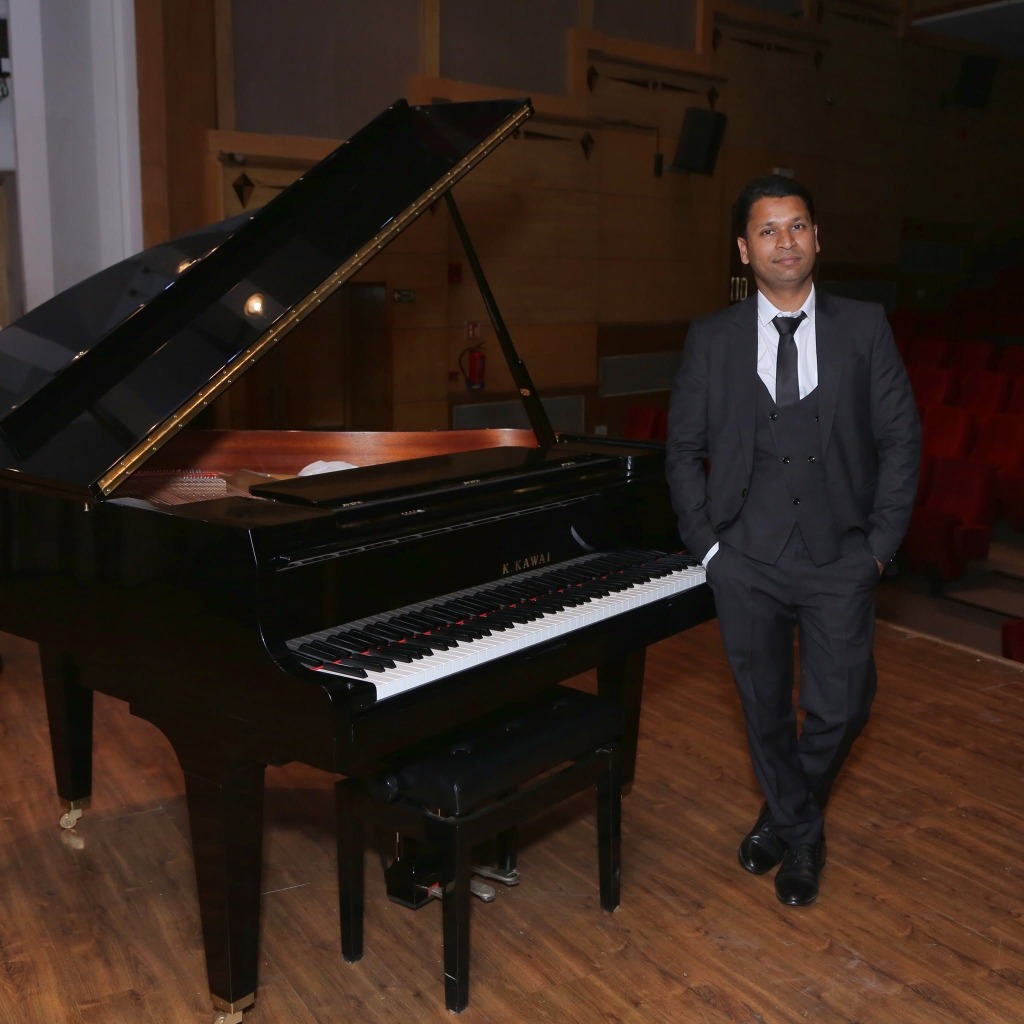
Syed Sajjad Rasul solves this fundamental challenge by delivering conservatory-grade classical piano mentorship directly to West Delhi. With a legacy spanning twenty-five years, YMCA institutional faculty credentials, and over 7,000 students mentored, Master Sajjad brings the unimpeachable standards of the European classical tradition straight to your estate or home salon.
The Business Family Advantage: Building Cognitive Grit & Neural Plasticity
Why Classical Piano is the Premier Extracurricular for High Achievers
In the homes of successful entrepreneurs and corporate leaders, education is viewed as an investment in long-term capability. Learning the piano at an elite level is widely recognized by neuroscientists as the ultimate full-brain workout. Reading dual staves simultaneously, translating complex visual symbols into sub-millisecond finger movements across eighty-eight independent keys, and coordinating independent pedal mechanics forces the brain to build dense bilateral neural bridges.
Students trained under Syed Sajjad Rasul develop vital cognitive faculties: • Executive Function & Sustained Focus: In an era characterized by fragmented digital attention spans, classical piano demands deep, sustained contemplation. Deciphering a polyphonic fugue by J.S. Bach requires intense mental discipline that directly translates into superior academic and strategic problem-solving abilities. • High-Stress Motor Control: Playing intricate passages at tempo requires instantaneous micro-corrections under pressure, building psychological resilience and emotional self-regulation. • Long-Term Strategic Vision: Progressing through the rigorous grades of Trinity College London teaches children that true mastery cannot be hurried; it is the compounding result of deliberate, daily precision.
Overcoming the 'Mall Academy' & Unweighted Keyboard Trap
Why Generic Group Classes Fail Serious Students in West Delhi
Many families in Punjabi Bagh and Rajouri Garden begin their musical journey by enrolling their children in neighborhood commercial music academies or shopping mall hobby centers. While well-intentioned, these centers operate on commercial volume rather than artistic excellence.
The structural flaws of commercial academies are profound: 1. The Electronic Keyboard Compromise: Students are typically placed on sixty-one-key semi-weighted or unweighted plastic synthesizers. These instruments feature spring-loaded mechanisms that offer zero dynamic resistance. When a student trained on plastic keys touches a real acoustic piano, their fingers collapse, their sound is hollow, and their fingers lack the strength to trigger the hammer mechanism effectively. 2. Divided Instructor Attention: In a class of four to six children, the instructor can spend at most eight to ten minutes listening to each student. Fundamental errors in wrist elevation, posture, and fingering go uncorrected for weeks. 3. Rotating Hobbyist Teachers: Commercial centers experience high instructor turnover. Students are subjected to constant changes in teaching styles, restarting books repeatedly and losing valuable developmental momentum.
Syed Sajjad Rasul offers the complete antithesis to this commercial model. Instruction is conducted strictly one-on-one, on acoustic or fully weighted eighty-eight-key hammer-action instruments, ensuring that every millisecond of lesson time is dedicated exclusively to your child's advancement.
Comprehensive Performance Matrix: West Delhi Music Academies vs. Private Mentorship
A Clear Analysis for Decision-Makers
This table demonstrates why discerning families in Punjabi Bagh choose private conservatory mentorship. When the objective is genuine artistic distinction, intermediate solutions only waste critical developmental years.
| Metric | Typical West Delhi Music Center | Syed Sajjad Rasul Private Mentorship |
|---|---|---|
| Class Structure | Group sessions (4 to 8 students) | 100% Bespoke 1-on-1 private mentorship |
| Lesson Location | Noisy commercial center / strip mall | In the privacy of your home or private studio |
| Instrument Focus | 61-key unweighted digital keyboards | 88-key acoustic uprights / baby grands |
| Pedagogical Pedigree | Part-time tutors, variable credentials | 25+ years experience, former YMCA faculty |
| Examination Rigor | Informal internal tests or hobby certificates | Trinity College London Initial to Grade 8 & Diplomas |
| Historic Success Rate | Unpublished, inconsistent results | Unblemished 100% exam distinction track record |
| Performance Prestige | Annual center gathering in classroom | Formal recitals at India International Centre (IIC) |
The Technical Mastery Roadmap: From Postural Architecture to Repertoire
Systematic Technical Training for West Delhi Students
Syed Sajjad Rasul’s curriculum is rooted in the Russian and German classical piano traditions, adapted thoughtfully for contemporary students. Training focuses on three core pillars:
1. Anatomical Posture & Kinetic Relaxation: True speed and dynamic expression do not come from muscle tension; they originate in absolute relaxation and the intelligent application of gravity. Students learn to sit with an upright spine, shoulders dropped, elbows loose, and wrists acting as flexible shock absorbers. Hand arches are shaped into strong, natural bridges, allowing the fingers to strike the keybed with independent clarity.
2. Scalic and Arpeggio Velocity: Scales are not treated as dry exercises, but as the fundamental architectural vocabulary of Western music. Students master legato phrasing, staccato articulation, and contrary-motion symmetry across all twelve major and minor keys.
3. Polyphonic Voicing & Tonal Contrast: A master pianist does not simply play notes; they orchestrate them. Under Master Sajjad's mentorship, students learn to bring out a singing soprano melody while keeping an accompanying Alberti bass whispered and transparent—a skill essential for performing Mozart, Beethoven, and Chopin.
Auditions and Enrollment for Punjabi Bagh & Rajouri Garden
Private In-Home Tuition Availability
Due to extensive teaching commitments and recital preparations, private in-home tuition slots across Punjabi Bagh, Rajouri Garden, Paschim Vihar, and Patel Nagar are strictly allocated. Families committed to providing their children with an authentic classical education are encouraged to apply early.
The admission process begins with a comprehensive diagnostic audition, during which Master Sajjad assesses the applicant’s auditory aptitude, manual dexterity, and motivational drive. Once accepted, a bespoke educational roadmap is formulated, setting clear milestones toward Trinity examination distinctions and prestigious recital debuts.
Inquire today via WhatsApp or phone to schedule your private consultation.
The Industrialist Family Pedagogy: Cultivating Discipline and Strategic Vision
Why West Delhi's Prominent Business Dynasties Prioritize Classical Piano
Across West Delhi's business communities—in Punjabi Bagh, Rajouri Garden, and Kirti Nagar—parents understand that business success requires immense discipline, calculated risk-taking, and long-term perseverance. In an age of digital distraction, cultivating these qualities in the next generation is a primary parental concern.
Classical piano mentorship under Syed Sajjad Rasul is structured specifically to instill these executive character traits: • Deliberate, Methodical Problem Solving: When a student encounters a technically demanding passage—such as an intricate cadenza in a Mozart Sonata—they cannot rush through it. They must deconstruct the passage, analyze the hand shifts, practice hands separately at half-tempo, and patiently build speed. This teaches young minds that complex challenges are solved through systematic decomposition. • Emotional Resilience and Self-Correction: In classical music, a mistake cannot be blamed on external factors. The student learns to listen with total honesty, take personal accountability for their sound, and make immediate real-time corrections. • Artistic Refinement as Cultural Capital: For business families engaging with international partners and global institutions, cultural fluency in Western classical music represents a timeless mark of distinction and sophistication.
Technical Repertoire Breakdown: Czerny and Hanon Adapted for Modern Students
Building Powerful, Independent Finger Bridges Without Chronic Strain
A frequent mistake in amateur music teaching is the unguided assignment of repetitive technical drills from Hanon's The Virtuoso Pianist or Czerny's Opus 599. When practiced with stiff wrists and flat fingers, these exercises cause severe tendon inflammation.
Master Sajjad introduces a modern, ergonomic approach to technical development: • The Drop-Roll Wrist Movement: After striking a chord or accent, the wrist drops gently to absorb kinetic shock and rolls upward to initiate the subsequent phrase, keeping the forearm completely loose. • Isolated Fourth-Finger Strengthening: Utilizing targeted five-finger expansion drills that isolate the ring finger's lumbrical muscles, overcoming the anatomical limitation of the shared extensor tendon. • Rotational Forearm Freedom: Teaching the subtle forearm rotation (pronation and supination) essential for playing effortless tremolos, broken octaves, and fast Alberti accompaniments without fatigue.
Overcoming the Cross-Town Commute: Premium In-Home Lessons in West Delhi
Maximizing Productive Study Hours for Busy Students
For families in Punjabi Bagh and Rajouri Garden, saving two to three hours of grueling Ring Road traffic several times a week is transformative. Rather than arriving at a South Delhi studio exhausted and irritable, students receive Master Sajjad in their own familiar, peaceful music salon.
This preserves mental energy for deep learning, allows parents to observe lessons directly, and ensures consistent weekly progress without scheduling disruptions caused by Delhi traffic.
The Punjabi Bagh Musical Salon: Reviving the European Chamber Tradition
Private Classical Recitals in West Delhi's Fine Residences
In the European classical tradition, the grand drawing rooms of cultured families served as the primary venue for musical innovation. Composers like Franz Schubert, Frédéric Chopin, and Franz Liszt debuted their greatest works not in cold municipal concert halls, but in intimate, candle-lit private salons surrounded by connoisseurs, intellectuals, and patrons.
Today, a similar tradition is blossoming across the sprawling private estates of Punjabi Bagh East and West. Forward-thinking families are transforming their drawing rooms into private musical salons, where young students perform curated programs for extended family, business associates, and visiting international dignitaries.
Under Syed Sajjad Rasul's direction, students prepare bespoke salon programs: • Curating a Narrative Repertoire: Selecting works that tell a cohesive musical story—beginning with the architectural symmetry of a Scarlatti sonata, transitioning into the poetic pathos of a Chopin Nocturne, and concluding with a virtuosic contemporary showpiece. • Program Notes and Verbal Introductions: Training the young pianist to speak before performing, articulating the composer's historical context, emotional inspiration, and formal structure. This practice instills verbal articulacy and commanding social poise. • Domestic Chamber Music Dynamics: Learning how to balance piano sound against the acoustic contours of fine wood paneling, silk upholstery, and private architectural elements, creating an unforgettable sensory experience for guests.