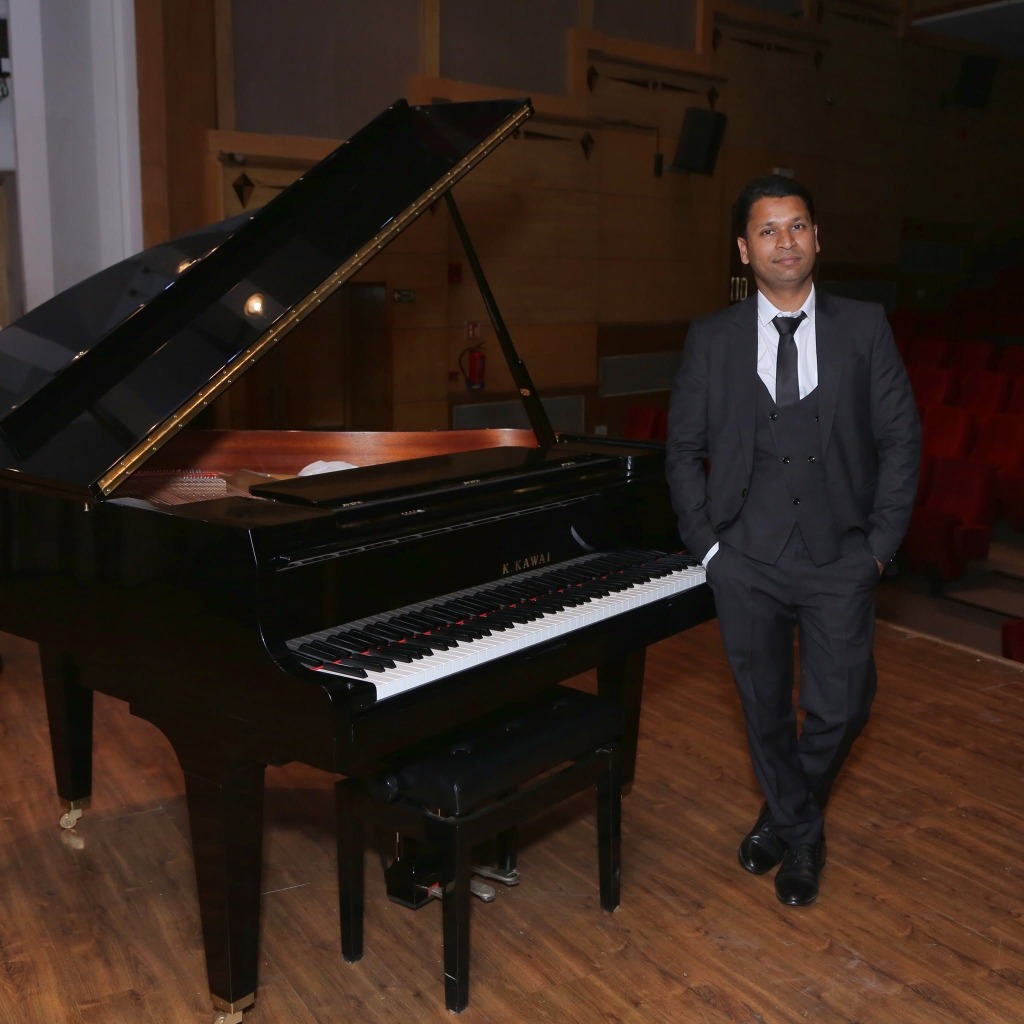
The Benchmark of Conservatory Piano Pedagogy in South Delhi
Cultivating Musical Refinement Across Delhi's Most Prestigious Enclaves
South Delhi represents the historical and cultural nucleus of Western classical music appreciation in northern India. From the verdant avenues of Vasant Vihar and Golf Links to the distinguished residences of Defence Colony, Greater Kailash, Anand Lok, and Chanakyapuri, families seek educational experiences that transcend routine extracurricular instruction. When parents invest in their children's artistic education, they look for authentic conservatory-grade rigor—the kind of mentorship that shapes character, builds neuro-cognitive architecture, and prepares young minds for global leadership.
For over two and a half decades, Syed Sajjad Rasul has stood as the definitive authority in private classical piano mentorship across Delhi NCR. Having guided more than 7,000 students and maintained an unparalleled 100% examination success rate with Trinity College London, his studio represents the gold standard of classical piano education. Unlike commercial music franchises that cycle through transient instructors and group lessons, Syed Sajjad Rasul delivers bespoke, uncompromising one-on-one instruction tailored to the individual physiology, cognitive pace, and artistic temperament of each student.
The South Delhi Residential Landscape: In-Home Studio Excellence
Eliminating Travel Friction While Preserving Pure Conservatory Standards
For high-net-worth families, diplomatic households, and senior corporate leaders in South Delhi, time is an invaluable asset. Navigating the arterial traffic between Vasant Vihar, Greater Kailash II, and central hubs often turns after-school lessons into exhausting ordeals. Syed Sajjad Rasul’s bespoke in-home mentorship brings the full weight of a European conservatory directly into your private residence.
Mentorship sessions are conducted in your personal living salon or dedicated music room, allowing the student to learn in an environment of complete focus, comfort, and psychological security. During these private sessions, Master Sajjad does not merely instruct; he calibrates the physical and acoustic relationship between the student, the instrument, and the room. Every session becomes a masterclass in tone production, postural ergonomics, and interpretive artistry.
Acoustic Calibration: Touch, Room Dynamics, and Instrument Resonance
Why Private Home Mentorship Demands Meticulous Touch Diagnosis
One of the profound advantages of private home tuition is the ability to adapt technique to your specific instrument. An acoustic piano—whether a handcrafted German upright or a Japanese concert grand—is a living entity of wood, felt, and tensioned high-tensile steel wire. The ambient humidity of Delhi, seasonal temperature fluctuations, and room finishes (marble flooring versus Persian rugs, floor-to-ceiling glass versus heavy drapes) radically transform acoustic feedback.
Under the guidance of Syed Sajjad Rasul, students learn how to voice chords specifically for their domestic acoustic environment: • Weight Allocation and Finger Articulation: Moving beyond superficial finger-tapping to channel the natural weight of the shoulder and arm directly through curved, supple finger arches. • Pedal Nuance and Resonance Control: Mastering the subtle mechanics of the damper pedal—distinguishing between rhythmic pedaling, syncopated legato pedaling, and half-pedal clearing to prevent harmonic muddiness in resonant marble-floored South Delhi salons. • Dynamic Range Calibration: Training the ear to perceive pianissimo (pp) that retains tonal core without dropping out, and fortissimo (ff) that rings with majestic depth rather than harsh, percussive clangor.
Comparative Analysis: In-Home Conservatory Mentorship vs. Commercial Academies
Why Delhi's Discerning Families Avoid Commercial Group Classrooms
The comparison above highlights a fundamental reality: true musical mastery cannot be mass-produced. When a student learns in a group setting, fundamental mechanical flaws—such as collapsed wrist arches, tense forearms, and improper thumb-under motion—invariably go unnoticed. Over time, these flaws calcify into neuromuscular habits that cap progress at the intermediate level and cause chronic physical strain. Syed Sajjad Rasul's vigilant, undivided attention prevents these flaws from ever taking root.
| Educational Dimension | Commercial South Delhi Music Center | Syed Sajjad Rasul Private Mentorship |
|---|---|---|
| Student-to-Teacher Ratio | 4 to 8 students per classroom; divided attention | Strict 1-on-1 bespoke conservatory mentorship |
| Instructor Pedigree | Recent hobbyists or junior certificate holders | 25+ years mastery, ex-YMCA faculty, 7,000+ alumni |
| Instrument Standard | Unweighted digital keyboards, mismatched action | Student's private acoustic upright/grand piano |
| Curriculum Architecture | Generic, one-size-fits-all commercial syllabus | Bespoke roadmap aligned with Trinity distinctions & Ivy League goals |
| Touch & Posture Calibration | Infrequent observation; superficial corrections | Continuous micro-kinetic adjustment of wrist, arm & finger posture |
| Trinity Exam Distinction Rate | Inconsistent; variable pass-to-merit outcomes | Flawless 100% exam distinction track record |
| Auditorium Performance Opportunities | Internal studio recitals on portable keyboards | Prestigious annual showcase recitals at India International Centre (IIC) |
The Trinity College London Distinction Framework (Initial to Grade 8)
Deconstructing the Architecture of Examination Triumph
Trinity College London examinations are internationally recognized benchmarks of musical achievement, regulated by Ofqual in the United Kingdom and accepted worldwide by premier universities. Scoring a mere 'Pass' or 'Merit' is relatively straightforward; securing a 'Distinction' (87+ out of 100 marks) requires exceptional artistic maturity, flawless technical execution, and commanding musical presence.
Syed Sajjad Rasul’s pedagogical architecture systematically builds every component assessed by international examiners: 1. Repertoire Selection & Nuance (Pieces 1, 2, and 3): Selecting contrasting works from Baroque, Classical, Romantic, and 20th-century idioms that highlight the student's unique kinetic strengths while addressing technical weaknesses. 2. Technical Exercises & Scalic Velocity: Developing effortless agility across major and minor scales, harmonic and melodic variants, arpeggios, and contrary-motion drills with metronomic precision and dynamic shading. 3. The 30-Second Sight-Reading Scan Protocol: Teaching students how to dissect an unseen musical score in thirty seconds—identifying the key signature, time signature changes, rhythmic motifs, fingering pivots, and dynamic topography before a single note is struck. 4. Aural Perception & Musical Literacy: Developing an interior ear capable of identifying cadences (Perfect, Plagal, Imperfect, Interrupted), intervals, harmonic shifts, and stylistic eras purely through active listening.
From the Drawing Room to the Concert Hall: Stage Poise at the India International Centre
Transforming Technical Mastery into Unflinching Public Confidence
A comprehensive musical education does not remain confined behind closed doors. Performing on a concert grand piano before an audience of discerning critics, diplomats, and peers is an indispensable rite of passage.
Every year, students of Syed Sajjad Rasul take the stage at prestigious cultural institutions such as the India International Centre (IIC) in Lodhi Estate. These recitals are not casual student recitals; they are formal, black-tie celebrations of classical music where students present curated programs ranging from Bach's Well-Tempered Clavier to Chopin Nocturnes, Debussy Preludes, and sophisticated cinematic interpretations.
This rigorous stage experience inoculates young performers against performance anxiety, cultivates executive stage presence, and instills an innate poise that serves them throughout their academic and professional careers. Whether delivering a valedictory address, defending an academic thesis at Oxford, or leading a venture funding round, a student who has commanded a concert grand on stage carries an unshakeable inner authority.
Bespoke Scheduling & The Studio Audition Protocol
Securing a Highly Coveted Placement in South Delhi
Because Syed Sajjad Rasul maintains an uncompromising commitment to pedagogical depth, the number of in-home tuition slots across South Delhi is strictly limited. Sessions are allocated based on student dedication, instrument availability, and schedule compatibility across Vasant Vihar, Defence Colony, Greater Kailash, Chanakyapuri, and surrounding enclaves.
Prospective students and their parents are invited to participate in a diagnostic studio audition. This initial meeting assesses: • Hand span, knuckle arch stability, and natural finger articulation. • Rhythmic synchronization, auditory memory, and pitch discrimination. • Long-term artistic, academic, or international certification ambitions. • Domestic instrument suitability and recommended acoustic positioning.
To initiate an inquiry or arrange a private studio consultation, families may connect directly with Master Sajjad via WhatsApp or telephone.
Acoustic Architecture in South Delhi Estates: Dampening and Projection
Managing Marble Flooring, High Ceilings, and Glass Salons
South Delhi's luxury residences—from the sprawling bungalows of Vasant Vihar and Golf Links to the multi-level duplexes of Greater Kailash and Defence Colony—frequently feature expansive Italian marble flooring, double-height ceiling voids, and minimalist floor-to-ceiling glass glazing. While aesthetically breathtaking, these hard, non-porous surfaces create severe acoustic reflections, causing piano harmonics to bounce erratically and produce acoustic glare.
During private in-home mentorship sessions, Syed Sajjad Rasul personally evaluates and calibrates the physical acoustics of your music salon: • Strategic Rug Placement: Positioning a dense silk-wool or Persian rug beneath the piano keybed and soundboard to absorb direct floor reflections without deadening treble sparkle. • Soundboard Clearance and Angling: Adjusting the distance between an upright piano's soundboard and the wall (maintaining an optimal 10 to 15 cm clearance) or angling a baby grand at 45 degrees relative to glass walls to prevent flutter echoes. • Tone Cushioning Technique: Instructing students to adjust their attack velocity, utilizing the fleshy pads of the fingers to create a rounded, mellow tone that fills the room with warmth rather than harsh reverberation.
The 10-Year Musical Trajectory: From Initial Grade to Trinity Performance Diplomas
A Structured Roadmap for South Delhi's Ambitious Young Achievers
Mastery of the piano is not an arbitrary series of disconnected pieces; it is a meticulously sequenced, decade-long intellectual and physical journey. Under Master Sajjad's stewardship, each student follows a clear trajectory: • Foundation Years (Ages 6–8 | Initial to Grade 2): Cultivating upright spine posture, relaxed shoulders, fluid wrist motion, and instant reading fluency across treble and bass staves. Students build an intimate relationship with the acoustic keybed. • Developmental Mastery (Ages 9–12 | Grades 3 to 5): Developing rapid scalic velocity, contrary-motion symmetry, and polyphonic voice separation. Repertoire includes Bach Two-Part Inventions, Clementi Sonatinas, and Schumann Album for the Young. • Conservatory Distinction (Ages 13–16 | Grades 6 to 8 & ATCL Diploma): Mastering the great masterworks of Chopin, Beethoven, Debussy, and Rachmaninoff. Students achieve 87+ Distinction marks, complete Trinity performance diplomas, and build competitive music portfolios for international university applications.
Parent Partnership & Practice Architecture in South Delhi Homes
Cultivating an Environment of Focused Artistic Discipline
A world-class music education requires harmony between teacher, student, and parents. Syed Sajjad Rasul works closely with South Delhi families to establish an optimal domestic practice architecture: • The 45-Minute Focused Practice Block: Replacing unfocused multi-hour marathons with 45 minutes of rigorous, deliberate practice: 10 minutes of slow scales and Hanon finger drills, 25 minutes of hands-separate piece deconstruction, and 10 minutes of sight-reading or musical exploration. • Acoustic Sanctuary: Establishing dedicated practice hours free from household noise, televisions, or digital distractions. • Monthly Progress Audits: Providing parents with detailed qualitative reports on technical milestones, posture refinement, and upcoming examination timelines.